Managing the Pressure: A Scientific Guide to Preventing Fermentation Explosions and Geysers
Master the physics of fermentation pressure. Learn how to prevent bottle bombs, calculate CO2 volumes, and safely handle over-carbonated brews.
Contents
Pliny the Elder, writing in Naturalis Historia in the 1st century AD, described the Roman production of garum — fermented fish sauce — with an engineer’s attention to vessel failure. The massive ceramic amphorae used for garum were sealed with pine pitch. Mediterranean summer temperatures drove internal gas pressure high enough to crack those seals. Sometimes the amphorae themselves failed. Roman garum manufacturers learned through catastrophic loss — batches ruined, vessels destroyed — to leave a specific headspace, to use flexible rather than rigid pitch, and to manage production timing around seasonal temperatures. The pressure management principles they discovered through failure are identical to the ones governing your kitchen: headspace volume, seal flexibility, and temperature control. They had no formula for it. They had the ruins of whatever they got wrong.
You have Henry’s Law, Gay-Lussac’s Law, and a two-dollar plastic PET bottle from the grocery store. The physics are the same as in Pliny’s amphorae. The stakes in your kitchen are lower — but glass embedded in drywall at 2 a.m. is still glass embedded in drywall. Fermentation bottle explosions follow predictable rules. Understand those rules and the risk disappears. Here’s what you need to know.
The Chemistry of Fizz: Henry’s Law in Your Kitchen
To understand why bottles explode, we first have to understand what “fizz” actually is. When yeast consumes sugar, it produces two primary byproducts: ethanol and carbon dioxide (CO2). In an open jar, the CO2 simply escapes into the room. But when you seal that jar, you are forcing a gas to live in a liquid.
This is governed by Henry’s Law, which states that the amount of dissolved gas in a liquid is proportional to its partial pressure above the liquid.
When you seal your bottle, the CO2 fills the “headspace” (the empty air at the top). As more CO2 is produced, the pressure in that headspace increases. This pressure forces the CO2 molecules into the liquid. This is how you get carbonation. However, gas is highly compressible, but liquid is not. If your headspace is too small, the pressure rises exponentially. If your headspace is too large, you might never get enough pressure to force the gas into the liquid.
Temperature: The Hidden Pressure Multiplier
One of the most dangerous mistakes fermenters make is forgetting about the Gay-Lussac Law, which states that pressure is directly proportional to temperature.
Data point: Moving a fully carbonated 1-liter swing-top bottle from 40°F refrigerator storage to an 80°F kitchen counter can double the headspace pressure without a single additional gram of sugar fermenting. The CO2 doesn’t leave the liquid slowly — it comes out fast, all at once, the moment the solubility threshold shifts.
If a bottle is safely pressurized at 40°F (4°C) in the fridge, it might be sitting at 15 PSI. If you take that same bottle and leave it on a sunny counter where it hits 80°F (27°C), the pressure could easily double or triple, even without any more fermentation occurring. Heat makes CO2 less soluble in liquid, forcing it out of the brew and back into the headspace, where it hammers against the glass walls.
Understanding the Units: PSI vs. ATM
To talk about safety, we need to use the right units.
- PSI (Pounds per Square Inch): The standard unit of pressure in the US.
- ATM (Atmospheres): One ATM is the pressure of the air at sea level (about 14.7 PSI).
Most standard, high-quality swing-top bottles (like Grolsch-style bottles) are rated for about 58 to 90 PSI (roughly 4 to 6 ATM). For context, your car tires are likely around 32 PSI. A bottle of high-end Champagne is sitting at about 90 PSI.
When a bottle explodes, it’s usually because the internal pressure has exceeded the Tensile Strength of the glass. A typical “bottle bomb” occurs when the pressure hits 150+ PSI. At that point, the glass doesn’t just crack; it fails catastrophically, turning into high-velocity shrapnel.
The Glass Physics: Not All Jars are Created Equal
Look, I’m going to be blunt: Do NOT use decorative glass jars for carbonation.
I wasted one batch and nearly lost a cabinet shelf before I understood the difference between pressure-rated and decorative glass. Those beautiful thin-walled flip-top jars from discount home stores? That’s a trip to the emergency room waiting to happen. These jars are often made of Soda-Lime Glass that hasn’t been properly tempered or “annealed” for pressure. They often have visible seams or “bubbles” in the glass, which act as stress-concentration points.
Borosilicate vs. Soda-Lime
- Borosilicate Glass (like Pyrex): Highly resistant to thermal shock (going from hot to cold) but not necessarily stronger under pressure.
- Pressure-Rated Soda-Lime: This is what beer and champagne bottles are made of. They are designed with a specific thickness and a curved shape to distribute internal pressure evenly.
The Golden Rule: If you can’t find a “PSI Rating” or a “Pressure Tested” mark on the bottle, don’t use it for a second ferment. Stick to repurposed Grolsch bottles or high-quality brewing bottles from a reputable supplier.
Top-Rated Pressure-Safe Jars
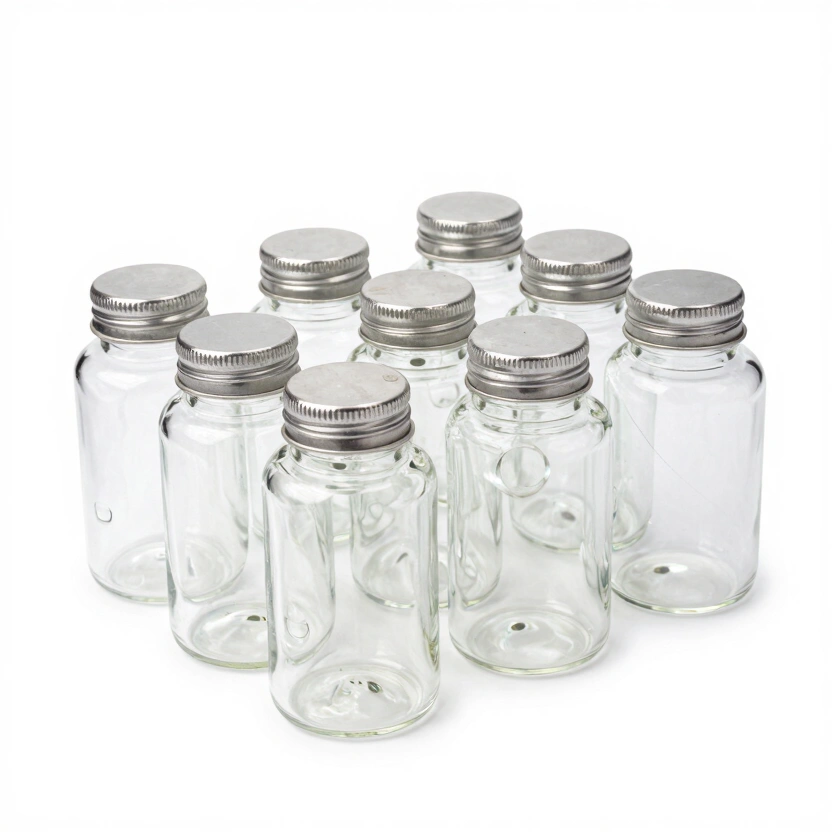
Artcome 10-Pack Glass Weights
Bulk set of heavy glass weights with easy-grip handles for large mason jar setups.
Check Price on Amazon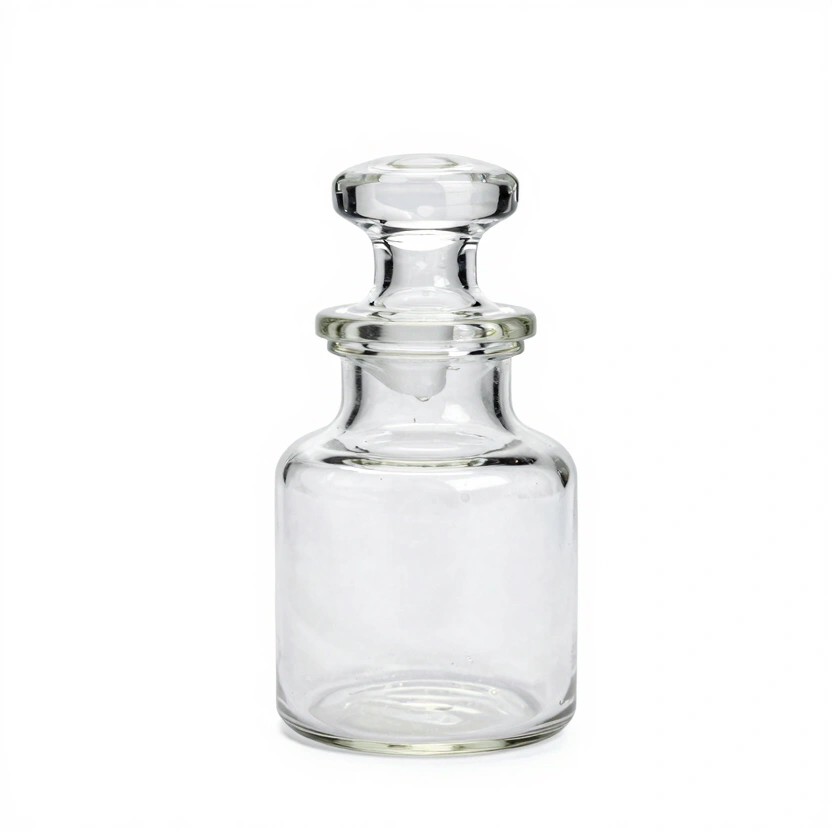
Westmark Glass Fermentation Weights
Heavy-duty glass weights from Westmark to ensure vegetables stay under the brine.
Check Price on Amazon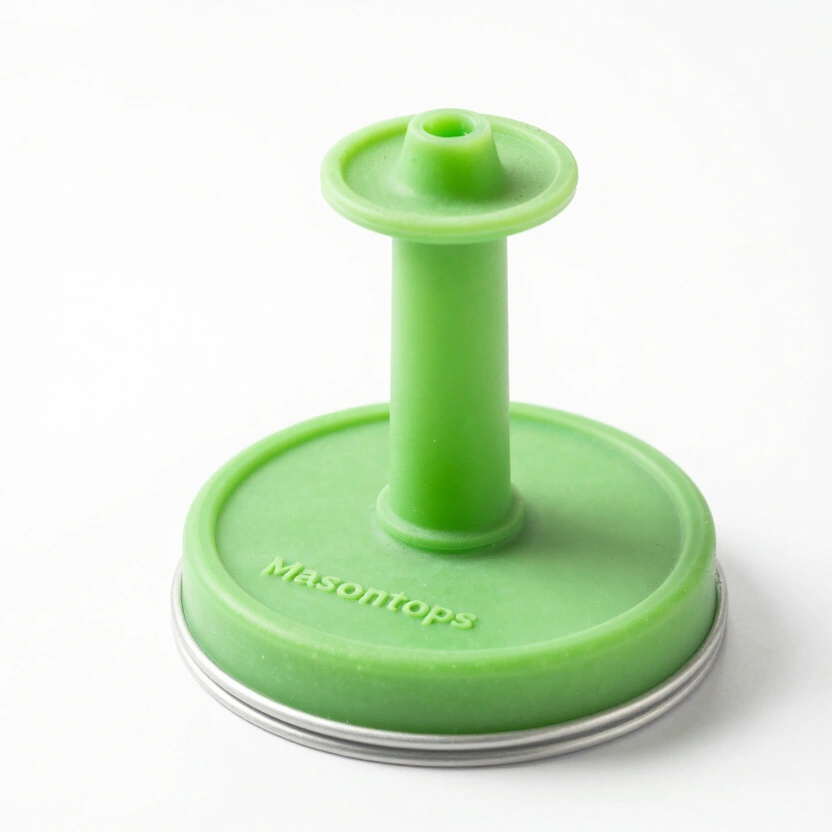
Masontops Pickle Pipe (Airlock Lids)
Waterless silicone airlock lids for easy, low-maintenance mason jar fermentation.
Check Price on Amazon* Affiliate links. Prices last updated March 3, 2026.
The Anatomy of a Bottle Bomb: Why it Happens
A “bottle bomb” is rarely an accident; it is a mathematical certainty based on three factors:
- Residual Sugar: This is the fuel. If you bottle your Kombucha while it’s still sweet, the yeast has a massive “fuel tank” to burn through.
- Active Yeast: If your brew is young and vibrant, the yeast is at its peak metabolic rate.
- Temperature: If the room is warm, the yeast works faster, and the CO2 is less soluble.
The “Back-Sweetening” Trap
Most guides skip over how dangerous this step actually is. Counter to how it seems, adding a small amount of sugar or fruit to “fix the flavor” is statistically the leading cause of bottle bombs in home fermentation.
Data point: 10 grams of added sugar per liter can produce roughly 5 liters of CO2 gas at standard temperature. In a sealed 1-liter bottle with 5% headspace, that translates to a pressure increase of approximately 45–60 PSI — on top of whatever pressure the bottle was already holding. Roman garum producers lost amphorae to exactly this principle. The physics haven’t changed.
You finish your first ferment, it’s a bit too tart, so you add a tablespoon of honey or a handful of fresh fruit “for flavor” and seal the lid. You’ve just handed the yeast a high-octane explosive. Fresh fruit is particularly dangerous because it introduces wild yeast and surface area for CO2 bubbles to form (nucleation points).
The “Burping” Myth: Why Tapping the Lid isn’t Safety
If you search for “how to prevent bottle explosions,” 90% of the advice will tell you to “burp your bottles” every 12 to 24 hours.
This is terrible advice for two reasons:
- It ruins the ferment: Every time you open the lid, you release the pressure, which means the CO2 comes out of the liquid. You are essentially resetting the carbonation clock to zero.
- It’s a safety hazard: The most dangerous time for a pressurized bottle is when you are handling it and changing the pressure. Opening a highly pressurized bottle can cause the lid to fly off with enough force to break a jaw, or cause the glass to fail in your hand.
The Better Way: Instead of burping, use Control Bottles. Fill one small plastic (PET) soda bottle with the same brew as your glass bottles. Throughout the second ferment, squeeze the plastic bottle. When it feels as hard as a rock (no give at all), your glass bottles are also fully carbonated. Move them ALL to the fridge immediately. Cold stops the yeast and makes the CO2 safe.
Calculating Carbonation: The Pro Way
If you want to move beyond “vibes,” you need to calculate your Priming Sugar.
In the brewing world, we aim for Volumes of CO2.
- Ales: 2.0 to 2.5 volumes.
- Sparkling Wine/Water Kefir: 3.0 to 4.0 volumes.
To reach 3 volumes of CO2 in a Liter of liquid, you typically need about 8 to 10 grams of sugar. If you know your ferment is “dry” (meaning the yeast ate all the original sugar), you can add exactly 9 grams of sugar per liter, and you will get perfect carbonation every time without any risk of explosion.
Handling the “Geyser”: Emergency Opening Procedures
We’ve all been there. You forget a bottle in a warm corner for 4 days. You pick it up, and it feels… heavy. Vibrating. You know it’s a geyser waiting to happen.
Do NOT just pop the top.
- The Cold Shock: Put the bottle in the coldest part of your fridge (or a bucket of ice water) for at least 12 hours. Cold liquid holds more gas. This reduces the “volatility” of the CO2.
- The Towel Shield: Wrap the bottle in a thick kitchen towel. This provides a grip and, more importantly, acts as a containment field if the glass fails.
- The Sink Method: Hold the bottle inside a deep sink.
- The Incremental Release: If it’s a swing-top, put your thumb firmly on the lid and just barely crack the seal. Let the gas hiss out for 30 seconds before fully opening.
The Geyser vs. the Explosion
A geyser (where the liquid foam shoots out) is a sign of Nucleation. This happens when the CO2 is released too fast and latches onto small particles (like fruit pulp). It’s messy, but it’s rarely dangerous to your physical safety. An explosion (where the glass breaks) is a sign of Structural Failure.
Data point: At 150+ PSI, soda-lime glass doesn’t crack — it shatters into high-velocity fragments. Emergency room data from fermentation-related injuries is not widely published, but the physics of glass failure are the same as industrial pressure vessel failure. The Roman garum manufacturers’ lesson was paid for in broken amphorae. Yours doesn’t have to be.
Frequently Asked Questions
Can I use Mason jars for secondary fermentation?
No. Mason jars are engineered for vacuum pressure — canning pulls the lid inward. Internal fermentation pressure pushes outward. The flat lid and square shoulders of a Mason jar are structural weak points under outward pressure. Failure typically happens at the lid rim or the bottom of the jar. Use Grolsch-style swing-tops or purpose-made brewing bottles rated for at least 58 PSI. This isn’t a preference — it’s the difference between intact glass and a trip to urgent care.
How fast can a bottle reach dangerous pressure in a warm kitchen?
Above 75°F (24°C) with a sugary brew like tepache or ginger beer: 36 to 48 hours is enough to reach dangerous levels. The plastic PET control bottle is not optional in those conditions. Pliny’s garum manufacturers had Mediterranean summers and no formula for headspace volume. You have a two-dollar squeeze bottle and Gay-Lussac’s Law. Use it.
Does the type of fruit I add matter for explosion risk?
Raspberries and pineapple are in a separate risk category. High sugar density plus enormous surface area equals rapid CO2 production and aggressive nucleation when you open the bottle. Pureed fruit ferments faster than chunks because the sugar is fully exposed, but produces fewer nucleation spikes on opening. Either way: fruit addition means your PET bottle needs checking every 12 hours, not every 24.
My bottle is completely flat after four days. What went wrong?
Check the rubber gasket on your swing-top first. Cracked, compressed, or misaligned gaskets won’t hold pressure — the CO2 bleeds out slowly overnight and you never build carbonation. Beyond that, look at the juice source: heavily pasteurized commercial juices kill yeast on contact. If your first ferment ran long and the brew is genuinely dry, there’s no residual sugar left to work with. Add 8-9 grams of plain white sugar per liter and reseal.
Is it safe to open a bottle I’ve left out too long?
Cold shock it first. Twelve hours minimum in the coldest part of your fridge — cold liquid holds more dissolved CO2 and reduces volatility on opening. Then wrap it in a thick kitchen towel, hold it in a deep sink, and crack the seal with your thumb pressing down on the lid. Let it hiss for 30 seconds before opening fully. Do not skip the cold shock. Do not open it warm over a countertop. Roman garum manufacturers learned to manage their vessels before cracking the seal. The principle applies.
The Verdict: Respect the Physics
Pressure-rated glass. Nine grams of priming sugar per liter. A plastic PET control bottle squeezed daily. Three variables. All measurable. All controllable. Pliny’s garum manufacturers learned headspace management through the rubble of broken amphorae and lost product. You have the formula they were working toward without knowing it. The risk isn’t unpredictable — it never was. It’s just physics that hasn’t been respected yet.
Temperature affects every stage of fermentation beyond carbonation — lag phase, yeast activity, acid production rate. The Fermentation Temperature Control Guide covers the full curve.