The Visual Masterclass: Distinguishing Kahm Yeast, Mold, and Biofilms
Is that white film on your sauerkraut mold or just harmless kahm yeast? Learn how to identify and prevent fermentation failures.
Contents
Around 350 BC, Aristotle described anthos oinou — “the flower of wine” — a thin white film that formed on the surface of open wine vessels during summer. He recorded it in Meteorologica as a transformation of the wine’s pneuma, its living spirit. His description was precise: flat, white, film-like, appearing in warm weather, tasting bitter. He was describing kahm yeast. It would take 2,200 more years for microbiology to supply the mechanism — Pasteur’s 1857 identification of surface pellicle-forming yeasts — but Aristotle’s visual record is so accurate that his words could appear in a modern fermentation troubleshooting guide unchanged. The kahm yeast vs. mold distinction is ancient. The vocabulary for making it precisely is new.
You open the jar after a week of waiting. A white film covers the surface. Stomach drops. First instinct: discard. But that film is either a harmless surface yeast that Aristotle would have recognized, or a mold colony with mycelium already threading through your vegetables — and the difference is visible to the naked eye in under 30 seconds. Here is the cellular framework that separates them, and the 10-step rescue protocol for the case that can be saved.
The Microbial Landscape: Why Surface Growth Happens
Fermentation is a battle for territory. When you submerge vegetables in a salty brine, you are creating an environment that favors lactic acid bacteria (the “good guys”). However, the surface of that brine is where the water meets the air. This interface is a high-risk zone.
Even in a perfect setup, tiny amounts of oxygen can linger. This oxygen is the fuel for aerobic organisms. While your Lactobacillus work deep underwater without oxygen, other microbes are hovering at the surface, waiting for a chance to land. Whether they turn into a harmless yeast film or a toxic mold colony depends entirely on your hygiene, your salinity, and your environmental control.
Biology 101: Yeast vs. Fungus
Picture this: a jar of pepper mash that has been quietly fermenting for eight days. You pull it out of the cabinet and tilt it toward the light. Something white coats the surface — thin as a sheet of paper, wrinkled in the center like crumpled tissue. You can feel your pulse in your throat. In five minutes, you will know exactly what it is.
To identify what’s in your jar, you have to understand what these organisms are at a biological level.
What is Kahm Yeast?
“Kahm” isn’t a specific species; it’s a term used for a variety of pellicle-forming yeasts.
- Structure: These yeasts are single-celled organisms that link together to form a thin, buoyant mat. They don’t have roots. They simply float on the surface tension of the liquid.
- Metabolism: They are “acid-eaters.” They consume the lactic acid your bacteria produce. This raises the pH, making the ferment less stable over time.
What is Mold?
Molds are multicellular fungi. Unlike yeast, mold develops a complex network of “roots” called mycelium.
- Structure: Mold grows upward and downward. What you see on the surface is the “fruiting body”—the part that produces spores. The dangerous part is the mycelium beneath the surface, which can weave through your entire batch.
- Danger: Molds produce mycotoxins that can cause everything from mild allergic reactions to severe long-term organ damage.
The Visual Masterclass: How to Spot the Difference
Honestly, 80% of the jars people send me photos of asking “is this mold?” are kahm yeast. But that remaining 20% — actual mold — needs an immediate, different response. So the visual diagnosis matters.
When you look into your jar, you need to be a detective. Bring a bright flashlight and look for these specific indicators.
The “Fuzz” Factor (Texture)
This is the #1 rule of fermentation.
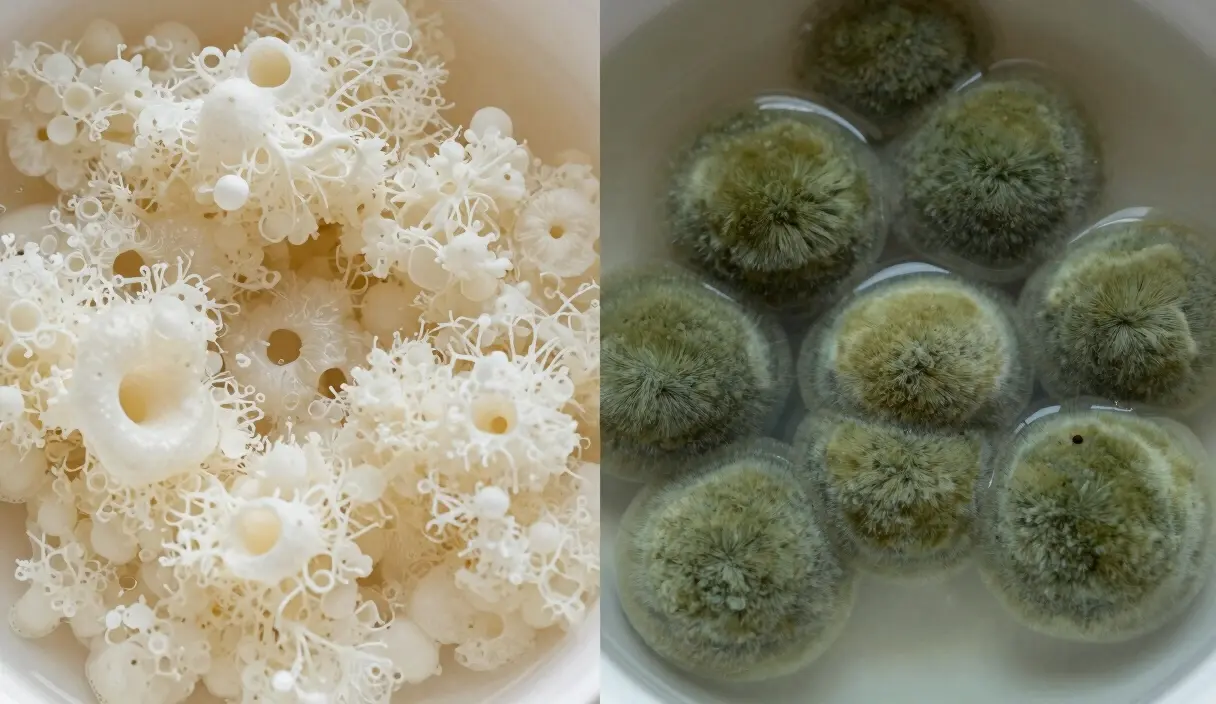
- Mold is Fuzzy: If it looks like velvet, has tiny hairs, or looks like a miniature forest of fluff, it is mold. Mold has a 3D structure that rises off the surface.
- Kahm Yeast is Flat: Kahm looks like a dusty film, a spiderweb, or a piece of crumpled tissue paper. It can be wrinkled, but it will never have hairs. It follows the contours of the water.
The Color Code
- White/Cream: This is the “Ambiguous Zone.” Both Kahm yeast and young mold can be white. If it’s white, you have to check the texture (fuzziness).
- Blue, Green, Black, or Pink: This is the “Danger Zone.” These colors are almost always produced by mold spores. If you see any color other than white or cream, the batch is compromised.
- Bright Red/Orange: This is rare but often indicates a bacterial contamination. Discard immediately.
The Pattern
Kahm yeast often forms geometric, fractal patterns. It looks like frost on a windowpane. Mold grows in irregular, circular “islands” that eventually merge into a solid carpet.
The Smell Lexicon: Let Your Nose Be Your Judge
Sometimes your eyes can’t quite decide, but your nose knows.
- The Healthy Ferment: Sour, tangy, yeasty, or slightly sulfurous. It should make your mouth water, like a sharp pickle or a good sourdough.
- The Kahm Yeast Scent: Strong bread-like aroma, slightly cheesy, or nutty. It might smell like a dusty cellar. While not “appetizing,” it shouldn’t trigger a gag reflex.
- The Mold/Rot Scent: Musty (like a damp basement), dusty, or putrid (like garbage left in the sun). If the smell is sharply unpleasant, it is mold or putrefaction. Trust your gut.
Chemical Sabotage: How Kahm Yeast Ruins Your Batch
The jar looked fine. The white film was thin, flat, non-fuzzy — textbook kahm yeast. You decided to wait it out. Two weeks later the pH was 5.1 and the mash smelled off. That is the exact failure mode most guides skip over entirely.
Most guides treat kahm yeast as a minor annoyance. It isn’t. Left unmanaged, it can quietly return your ferment’s pH above 4.6 and open the door to pathogens. The benign appearance is the danger.
Even though Kahm yeast isn’t toxic, it is a chemical saboteur.
As we discussed in our pH Safety Masterclass, your goal is to drop the pH below 4.6. Your lactic acid bacteria work hard to produce that acid. Kahm yeast, however, consumes lactic acid as a food source. If you leave a thick mat of Kahm yeast, it will slowly “eat” the safety buffer your bacteria created. This raises the pH. Once the pH climbs back above 4.6, actual mold or even C. botulinum can take over.
The Rescue Protocol: A 10-Step Guide to Saving Your Batch
If you have confirmed that you have Kahm yeast (and NOT mold), you can usually save the batch.
Step 1: Minimum Disturbance
Do not stir the jar. We want to keep the growth on the surface.
Step 2: The Skimming Technique
Use a large, sterilized stainless steel spoon. Pull the yeast film toward the center and remove it in large pieces.
Step 3: Cleaning the Jar Walls
Take a clean paper towel dipped in white vinegar. Carefully wipe the inside glass walls above the brine level to remove leftover yeast cells.
Step 4: The pH Check
Use your digital pH meter. Is the brine still below 4.2? If yes, proceed. If above 4.6, discard.
Step 5: Liquid Top-Off
Replace lost brine with fresh 2-3% salt brine. Never use plain water.
Step 6: Verify Submergence
Ensure every single piece of vegetable is weighted down.
Step 7: The Vinegar Shield (Pro-Tip)
Lightly mist the surface of the brine with a tiny bit of white vinegar to create a chemical barrier.
Step 8: Fresh Seals
Discard your old lid or airlock and replace it with a clean, sanitized set.
Step 9: Temperature Adjustment
Move the jar to a slightly cooler spot (around 68°F).
Step 10: Intensive Monitoring
Check the jar daily for the next 72 hours.
These are the tools that make the biggest difference in prevention:
Mold Prevention Gear
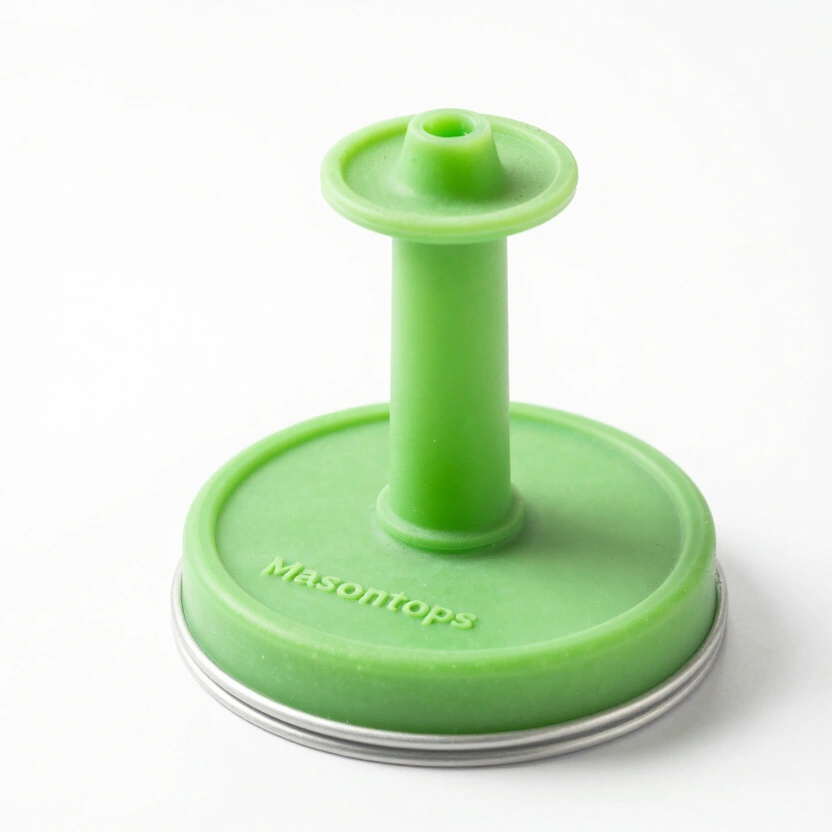
Masontops Pickle Pipe (Airlock Lids)
Waterless silicone airlock lids for easy, low-maintenance mason jar fermentation.
Check Price on Amazon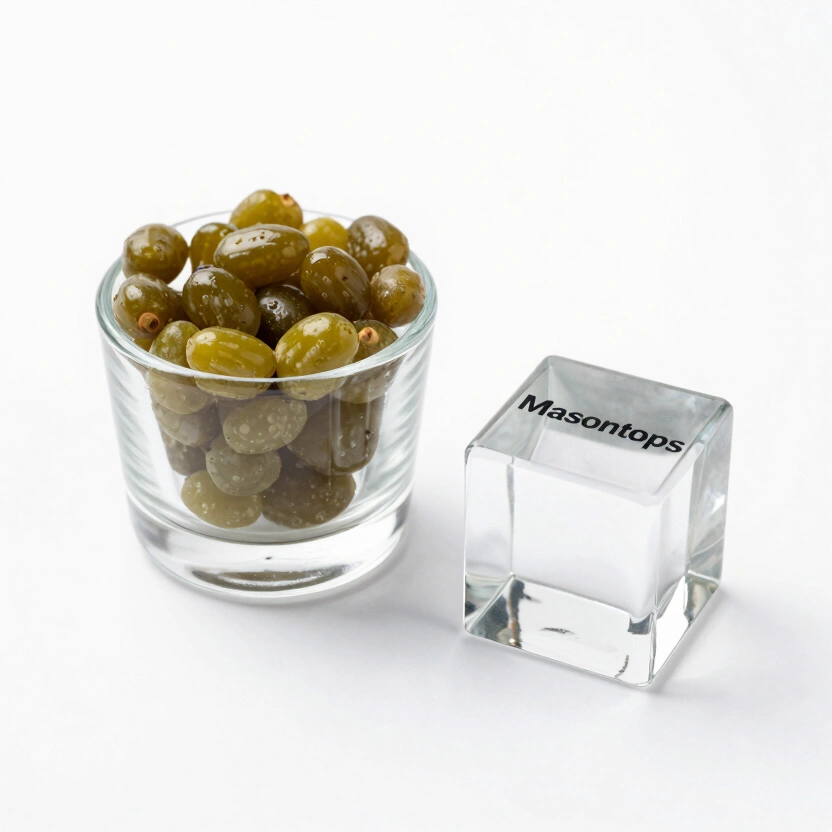
Masontops Pickle Pebbles
The original wide-mouth glass fermentation weights. Lab-tested and food-safe.
Check Price on Amazon
Masontops Complete Mason Jar Fermentation Kit
Complete set with airlock lids, glass weights, and vegetable tamper. Perfect for beginners.
Check Price on Amazon* Affiliate links. Prices last updated June 29, 2026.
Prevention Deep-Dive: How to Prevent Surface Growth
Twelve batches. That is how many it took before consistently reaching the end of fermentation with a clean surface. The variable that changed everything was not the airlock brand or the jar size. It was the salt ratio — specifically, moving from 2% to 3% for any ferment involving peppers, onions, or high-sugar vegetables.
Prevention is infinitely easier than a rescue operation.
Pillar 1: The Anaerobic Vacuum
Both mold and Kahm yeast are aerobic—they need oxygen. Lactic acid bacteria do not.
- The Power of Airlocks: Use a Pickle Pipe or S-Gärspund. These push out the oxygen, creating a literal vacuum of safety.
- Minimize Headspace: Leave only about 1 to 1.5 inches of air in your jar.
Pillar 2: The Salinity Buffer
I’ve run the same pepper mash recipe at 2% and 3% salt across a dozen batches. At 2%, kahm showed up every single time. At 3%, it appeared in maybe one out of five. That data point changed my default ratio permanently.
- Boost the Brine: For peppers or sugary vegetables, increase your salt to 3% or 3.5%.
- Uniform Dissolution: Always mix your brine thoroughly before adding it.
Pillar 3: Environmental Hygiene
- Dunking and Weighting: Use heavy glass weights to keep every bit of food submerged.
- Temperature Control: Aim for a steady 68°F–72°F (20-22°C).
- Keep it Dark: UV light can weaken the lactic acid bacteria colony.
Expert Case Studies: Real-World Scenarios
Case A: The “Ghostly Veil” on Sauerkraut
- The Sight: A thin, white, wrinkled film.
- The Verdict: Kahm Yeast. Skimmed and saved. If the white growth appears specifically on sauerkraut and you’re unsure whether it’s kahm or something more concerning, white mold on sauerkraut covers the edge cases in more detail.
Case B: The “Black Island” on Hot Sauce Mash
- The Sight: Small, circular dots of black fuzz.
- The Verdict: Mold. Discarded.
Case C: The “Pink Slime” on Cucumbers
- The Sight: Brine turned pinkish, glistening layer.
- The Verdict: Putrefaction. Salt was too low. Discarded.
Kahm yeast and mold look similar at first glance. They are not similar in consequence. One is a surface film that Aristotle documented 2,350 years ago and called the “flower of wine” — annoying, manageable, skimmable. The other is a multicellular fungus with mycelium below the surface producing mycotoxins that no amount of skimming reverses. The 30-second texture check — fuzzy versus flat — is all that separates those two outcomes. Do it every time you open a jar. The 10-step rescue protocol works when you catch kahm early; it is useless against established mold. Timing is everything here.
For the swirl test and poke test described step-by-step with visual reference images, the White Specks vs. Mold Catalog is the next logical read — especially for anyone working with hot sauce mash, where surface contact makes the stakes higher.
Frequently Asked Questions
How do I know for certain whether it is kahm yeast or mold when the color is just white?
Touch is the fastest test — sterilize a toothpick and lightly press the surface growth. Kahm yeast is flat and paper-thin; the toothpick slides across it without resistance. Mold has a 3D structure and the toothpick will sink slightly into fuzz. If you cannot distinguish by texture, use a flashlight held at a low angle: mold casts tiny shadows from its upright filaments. Kahm yeast, being flat, casts none. Either test takes under 10 seconds.
I stirred the white film into the brine accidentally. Is the batch ruined?
If it was kahm yeast, almost certainly not. Distributed yeast cells compete poorly against the established Lactobacillus colony at low pH, and they will largely die off over the next few days. Flavor impact is minimal. If it was actual mold — meaning it had fuzz, color, or 3D structure — stirring it in distributed the mycelium and any mycotoxins throughout the batch. Discard without tasting. Mycotoxins do not break down with pH or time.
Can kahm yeast appear even in a jar with an airlock?
Yes. Airlocks are not airtight at the liquid surface — they prevent external oxygen from entering, but a small amount of dissolved oxygen is already present in the brine and in any headspace. That residual oxygen is enough to sustain a thin kahm yeast film in warm conditions. Airlocks dramatically reduce kahm frequency; they do not eliminate it. Reducing headspace to under 1 inch is more effective for surface growth suppression than the airlock alone.
My hot sauce mash gets kahm yeast every single batch. What am I missing?
Three variables account for almost all chronic kahm yeast: salt below 2.5% for high-sugar pepper mashes, temperatures consistently above 72°F, and surface contact with oxygen because the mash isn’t fully pressed below the brine level. Fix all three simultaneously. Use 3% salt, move to a cooler location (ideally 65°F-68°F), and use a Pickle Pipe or S-Gärspund airlock combined with a small glass weight on top of the mash. The Masontops Complete Kit handles the weight and airlock in a single purchase.
When does kahm yeast flavor permanently damage a batch?
If kahm yeast is left in place for more than 5-7 days without skimming, the dusty, musty off-flavors from yeast metabolism permeate the brine and become extremely difficult to reverse. A light film that appeared yesterday and is skimmed today will leave no detectable flavor trace. A thick mat that colonized the surface for two weeks will make the final product taste like a musty cellar. Skim early, skim completely, and check pH immediately after.
Related Articles
Fermenting Parsnips and Turnips: Mastering the Forgotten Roots
Why are parsnips and turnips the secret weapons of the crock? We explore the science of starchy root fermentation, sweetness, and savory depth.
Koji-Kin: The 'National Fungus' and its Enzymatic Power
Master the foundation of Japanese fermentation. We explore the science of Aspergillus oryzae and how to grow koji at home.