The Visual Masterclass: Distinguishing Kahm Yeast, Mold, and Biofilms
Found white spots in your jar? We provide a complete visual catalog to help you distinguish between harmless yeast, beneficial sediment, and dangerous mold.
Contents
In the 1620s, Dutch East India Company (VOC) ships departing Amsterdam for the East Indies carried sauerkraut in sealed barrels as anti-scurvy rations. Before loading, VOC warehouse inspectors in Amsterdam ran what the company’s records describe as a “barrel inspection” — a systematic check of every fermented vegetable barrel destined for the voyage. The inspection protocol made a specific visual distinction: white surface spots that were flat and powdery were listed as “acceptable.” White formations that were raised, fuzzy, or colored were listed as “cause for rejection.” No microscopes. No pH strips. Just trained eyes making a taxonomic call that separated safe cargo from contaminated cargo. The taxonomy they drew — flat and powdery versus raised and fuzzy — is exactly the same one you need to apply when you open a jar today.
This morning you found white specks somewhere in your jar. Surface, bottom, or floating in suspension — the location already tells you something. So does the texture. So does whether the brine smells sharp and sour or damp and musty. White is the most complex color in the fermentation spectrum. It covers four completely different phenomena with four different safety outcomes. Here is the full visual catalog, plus the mechanical tests that give you certainty when sight alone isn’t enough.
The Taxonomy of White: Defining the Residents
To identify what is in your jar, you must first understand the four major categories of white growth.
Kahm Yeast (The Surface Veil)
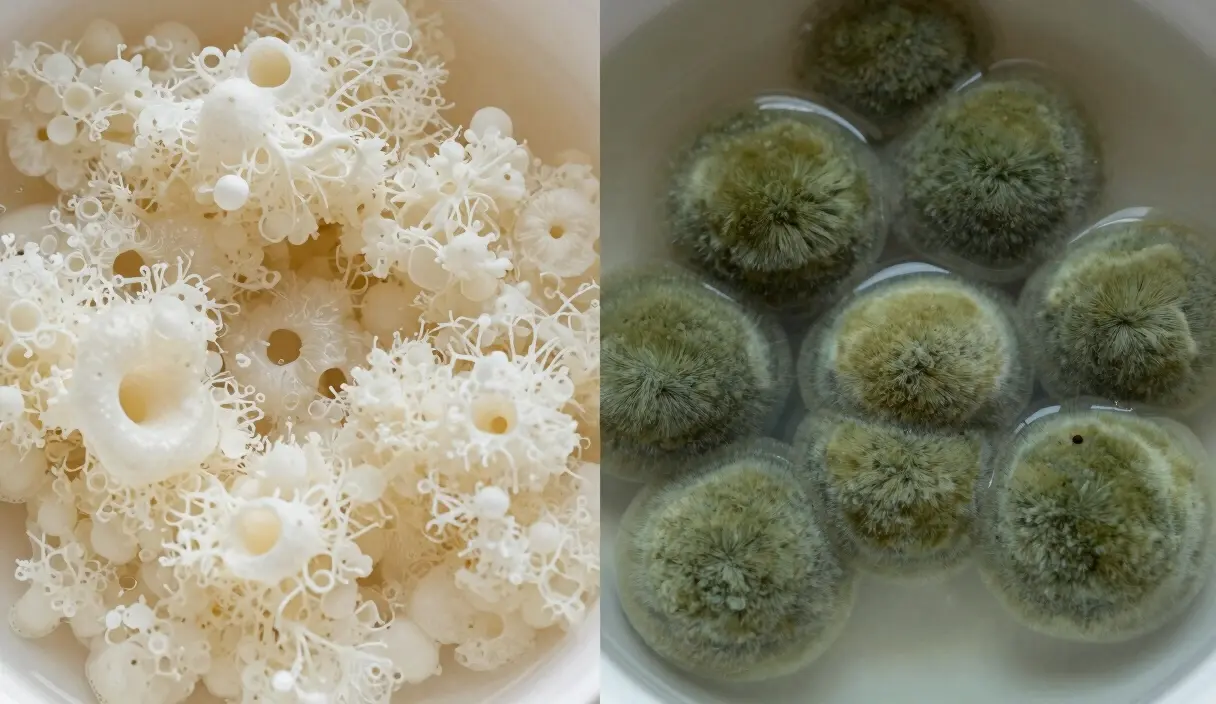
Kahm yeast is a collection of pellicle-forming yeasts (often Mycoderma or Candida).
- The Sight: It starts as tiny, flat white dots that eventually merge into a thin, translucent film. As it matures, it becomes wrinkled, looking like silk or a “brain.”
- The Physics: It is two-dimensional. It floats on the surface tension of the water and does not rise into the air.
- The Safety: Technically safe, but chemically a saboteur—it eats the lactic acid and raises the pH.
White Mold (The Fuzzy Intruder)
True mold is a multicellular fungus from genera like Aspergillus or Penicillium.
- The Sight: It looks like white velvet, cotton balls, or tiny white hairs. It is distinctively 3D and “fuzzy.”
- The Physics: It has “height.” It grows upward from the surface into the headspace of the jar.
- The Safety: Discard. Mold produces mycotoxins that can penetrate deep into the brine.
Yeast Sediment (The Sunken Cloud)
Billions of lactic acid bacteria and yeasts live, work, and die in your jar.
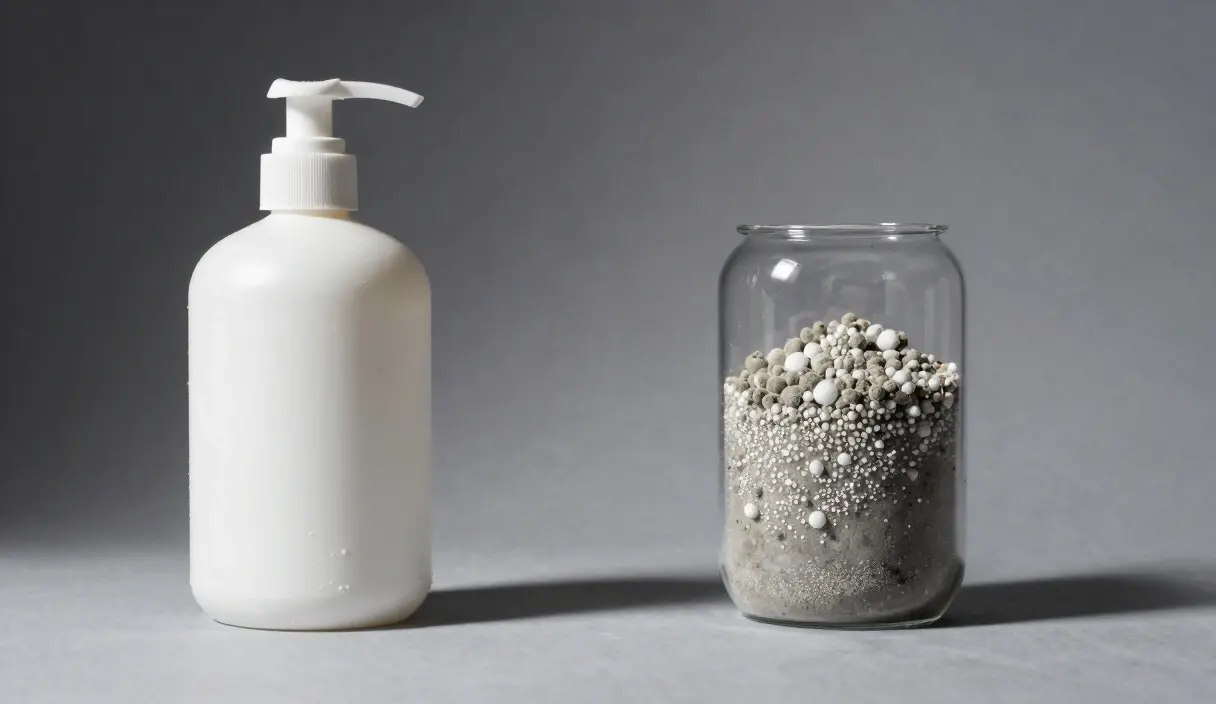
- The Sight: A fine, white, chalky powder that settles at the bottom of the jar or coats the sides of the vegetables.
- The Reality: This is Sediment, not surface growth. It is a sign of a very successful, high-population fermentation.
Pectin Ghosts (The Wispy Veils)
In high-quality, fresh vegetables, pectin can sometimes be released into the brine.
- The Sight: Wispy, ghost-like clouds that hang suspended under the liquid. They look like tiny pieces of jellyfish.
- The Reality: These are non-biological structures. They are harmless and indicate that your vegetables were incredibly fresh.
The “Poke and Swirl” Test: Mechanical Identification
If you cannot tell by sight alone, you can use physics to help you identify the growth.
Picture a VOC inspector in 1622, lantern held low over an open barrel, squinting at the surface. He isn’t guessing — he’s running a checklist. Flat or raised. Powdery or fuzzy. That same two-second check, applied to your jar right now, answers the question.
The Swirl Test
Gently swirl your jar.
- Kahm Yeast Behavior: The film will break into sharp, jagged, “geometric” flakes that float independently. It looks like ice breaking on a pond.
- Mold Behavior: Mold patches are held together by a network of roots (mycelium). They will stay in one piece or drift as a solid “island.” They do not shatter.
- Sediment Behavior: The white powder at the bottom will swirl up into a “snow globe” effect and then slowly settle back down.
The Poke Test
This is the step most people skip — don’t. The poke test takes ten seconds and tells you more than five minutes of staring through the glass.
Use a clean toothpick to touch a white speck.
- If it collapses: It was likely an air bubble or a tiny piece of yeast.
- If it has “spring” or texture: It is biological. If the toothpick comes away with “hair” attached, it is mold.
Microbial Sabotage: Why White Matters
While Kahm yeast and pectin clouds are “safe,” they are not desirable. To be a precision maker, you must understand the chemical impact these residents have on your jar.
Picture your jar two weeks in: brine cloudy, bubbles steady, everything smelling right. Then you tilt it toward the light and see a thin white film forming on the surface. That film is Kahm yeast beginning its slow erosion of the lactic acid you spent weeks building. Harmless, yes. Inert, no.
The pH Saboteur
Honestly, this is the detail that changed how I approach every batch. Kahm yeast looks harmless — and technically it is. But leave it long enough, and it silently erodes your safety margin.
Kahm yeast is an acid-metabolizer. Its primary food source is the lactic acid produced by your Lactobacillus.
- The Impact: If you leave a thick mat of Kahm yeast on your ferment, it will slowly raise the pH.
- The Risk: Once the pH climbs back above the 4.6 safety line, your jar is no longer protected against botulism.
The Rescue Protocol: Handling the White Spectrum
If you have determine you have Kahm Yeast or very minor white mold, follow this surgical protocol.
Step 1: Stillness
Do not move the jar. We want the surface growth to stay on top.
Step 2: The Clean Sweep
Use a large, sterilized stainless steel spoon. Pull the white film toward the center and lift it out.
Step 3: The Rim Wipe
Take a clean paper towel dipped in white vinegar. Wipe the inside glass walls of the jar above the brine line.
Step 4: The Acidification Boost
Add 1 tsp of apple cider vinegar to the surface. This drops the local pH, creating a chemical barrier.
These are the tools that ensure a professional diagnostic approach:
Top Diagnostic Tools
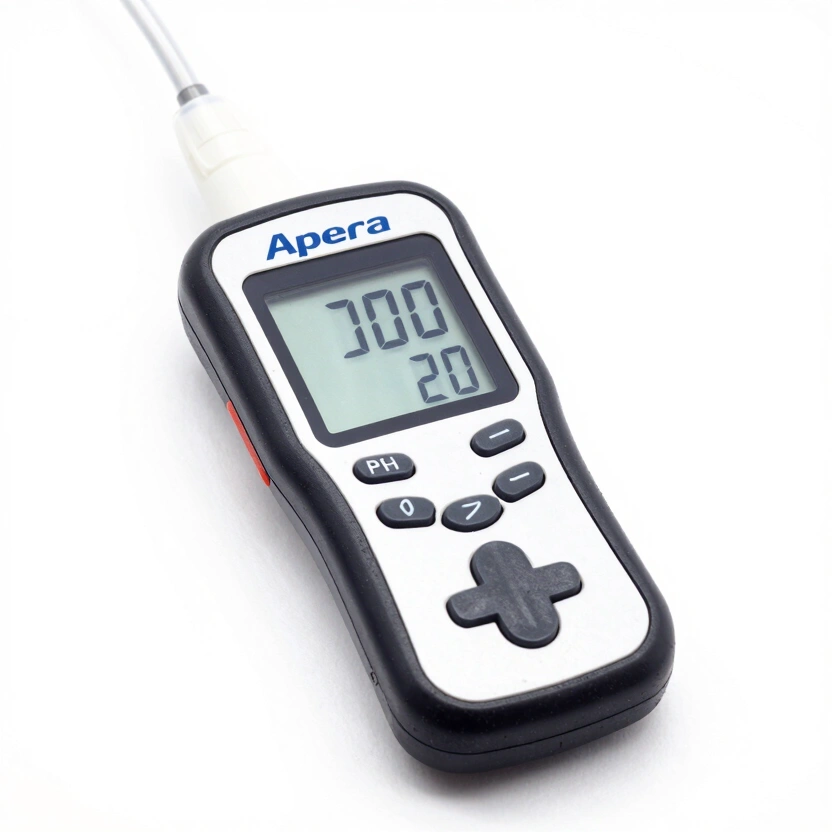
Apera Instruments PH20 pH Meter
Professional-grade digital pH tester, essential for verifying safety in low-acid ferments.
Check Price on Amazon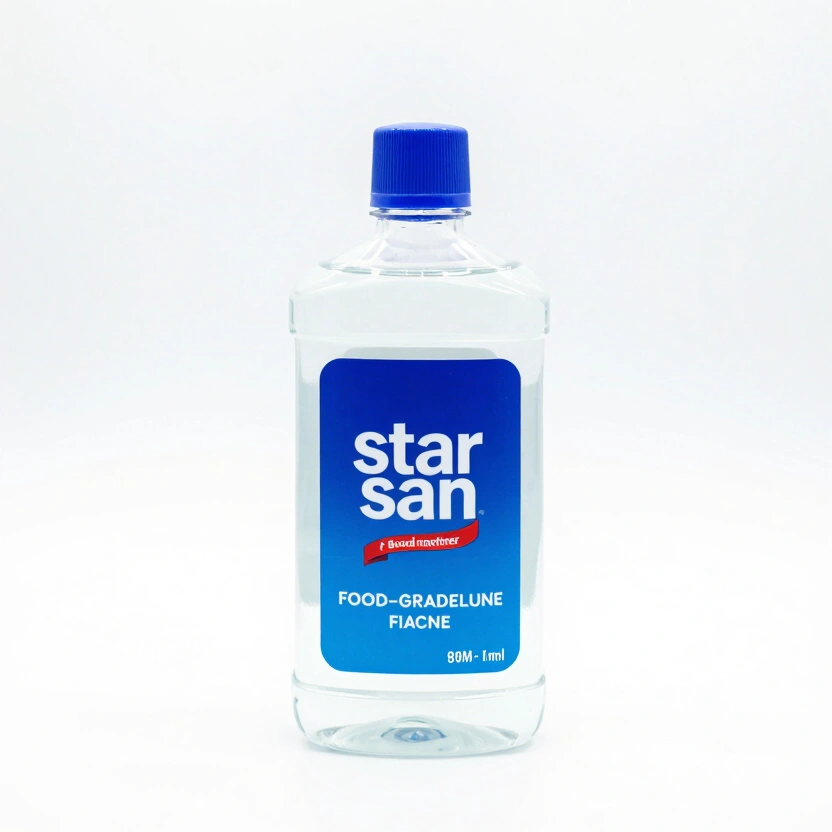
Star San Food-Grade Sanitizer
The gold standard for no-rinse sanitization in home brewing and fermentation.
Check Price on Amazon
Artcome 10-Pack Glass Weights
Bulk set of heavy glass weights with easy-grip handles for large mason jar setups.
Check Price on Amazon* Affiliate links. Prices last updated March 3, 2026.
Verification: Proving Safety with Data
After a rescue, you cannot rely on sight alone.
- pH Check: Use your digital pH meter. The brine must be below 4.0 for a successful rescue.
- The Smell Check: If the white specks are accompanied by a musty or “basement” smell, the batch is contaminated by fungal mycelium deeper than you can see. Discard.
Biofilm Physics: Why the Surface Matters
Fermentation is an anaerobic process, but the very top of your liquid is the Interface Zone.
- Oxygen Diffusion: Oxygen can travel about 1-2 centimeters into a still liquid. This is why growth only happens at the top.
- Submergence: This is the scientific reason for the rule: “Below the brine, everything is fine.”
Prevention Mastery: Design for Zero Growth
I lost a two-week kimchi batch to kahm because I left a single cabbage shred floating above the brine line. That was the only oxygen bridge it needed.
One shred above the brine line. Two weeks of work. One discovery at 7 a.m. of a jar that had to be emptied. The VOC inspectors rejected entire barrels for less. The lesson is the same in both centuries: submersion is not optional.
Prevention is infinitely easier than a surgical rescue.
The Headspace Rule
Oxygen is the catalyst for all white growth. Leave only 1 inch to 1.5 inches of headspace. This small volume is easily displaced by the heavy CO2.
The Brine Barrier
The faster you establish an anaerobic seal, the safer your jar. Use an Airlock for sugar-heavy vegetables which are most prone to white blooms.
Salinity and White Growth: The 3% Anchor
Low salinity is an open invitation for Kahm yeast.
- The Standard: 2% salt is for safety, but 3% salt is for “control.”
- The Mechanism: Higher salt concentrations increase osmotic pressure on the wild yeasts, making it harder for them to form a biofilm.
Visual Catalog Summary: The Quick Check
| Growth Type | Location | Texture | Safe? |
|---|---|---|---|
| Kahm Yeast | Surface | Flat, wrinkled, non-fuzzy | Yes (remove) |
| White Mold | Surface | 3D, fuzzy, hairs | No (discard) |
| Yeast Sediment | Bottom | Chalky powder | Yes (harmless) |
| Pectin Ghosts | Suspended | Wispy, jellyfish-like | Yes (harmless) |
The swirl test, the poke test, the pH check — not advanced techniques. The standard diagnostic sequence. The VOC inspectors in 1622 had none of those tools and still developed a reliable visual protocol through accumulated observation. You have a pH meter, a toothpick, and this catalog. Location tells you most of it. Texture confirms it. Acidity seals the case. Three data points, thirty seconds, no guessing.
When the poke test finds fuzz and you need a step-by-step salvage decision, the Kahm Yeast vs. Mold Guide covers the full 10-step rescue protocol and the exact point at which rescue becomes a bad idea.
Frequently Asked Questions
The white film on my sauerkraut shattered into jagged pieces when I swirled the jar. Is that safe?
Kahm yeast. That “ice breaking on a pond” fragmentation pattern is the swirl test result for pellicle-forming yeasts — the film breaks into geometric shards because it has no root network holding it together. Scoop it out cleanly, verify pH below 4.0, top off the brine, and continue. It is chemically safe but will raise your pH if left long enough.
My garlic jar looks like a snow globe. Is the white cloudiness mold?
Garlic produces some of the most dramatic sediment in vegetable fermentation, due to its starch content and the activity it generates in LAB populations. White cloudiness in a garlic jar — especially at the bottom — is almost always a massive Lactobacillus bloom. The VOC inspectors’ “flat and powdery” classification applies here. Surface fuzz is a different category. Surface fuzz is the thing to watch.
Can white mold have black spots in it?
Yes — and that escalates the response. Black spots mean the mold is sporulating. Airborne spores can travel and seed other ferments in your kitchen. Discard that batch, sterilize the jar with a bleach solution, and check anything else fermenting nearby. This is not the same situation as a surface kahm rescue.
Why do I see white specks coating the sides of the vegetables below the brine line?
That is yeast sediment that has settled on the vegetable surfaces — a sign of a very active, high-population fermentation. It will look like a white coating or chalky dusting on the carrot sticks or cabbage strands. Harmless. Wash off before eating if the visual bothers you. The VOC catalogue would have stamped this barrel “acceptable” without hesitation.
Can I ever back-slop from a jar that had surface growth?
If the growth was kahm only — confirmed flat, no fuzz, pH held below 4.0 — the brine is technically usable for back-slopping. If there was any fuzzy white mold present, do not use that brine. Mycotoxins are heat-stable and water-soluble. They don’t disappear when you pour brine into a new jar.
Related Articles
The Visual Masterclass: Distinguishing Kahm Yeast, Mold, and Biofilms
Is that white film on your sauerkraut mold or just harmless kahm yeast? Learn how to identify and prevent fermentation failures.
The Science of Slime: Troubleshooting Pediococcus and Texture Issues in Fermentation
Is your sauerkraut brine thick and stringy? Learn about Pediococcus and how to fix slimy fermentation without throwing it away.
The Scoville Scale and Fermentation: Does Heat Level Change Over Time?
Does fermentation make hot sauce hotter or milder? We explore the stability of capsaicin, pH impact on heat perception, and the Scoville scale.