
The Anaerobic Mandate: Why Submergence is Non-Negotiable in Fermentation
Oxygen is the enemy of successful fermentation. We explain the science of anaerobic environments and how to master brine levels for safety.
Contents
In 1768, Captain James Cook loaded barrels of sauerkraut onto HMS Endeavour and solved scurvy — a disease that had killed more sailors than enemy cannon fire. But Cook’s achievement wasn’t just nutritional. It was a demonstration of anaerobic science, centuries before that term existed. The sauerkraut held because the lacto-fermentation process had created a sealed, acid environment where harmful bacteria could not survive. The brine physically excluded oxygen. The salt selected for the right microbes. And the sealed barrel maintained the conditions that those microbes needed to produce enough lactic acid to crash through pH 4.6. Three years at sea. Zero scurvy deaths. The physics worked.
That same physics governs every jar on your counter. “Below the brine, everything is fine” is not a folk saying — it is a statement of microbial ecology. Anaerobic fermentation requires the physical and chemical exclusion of oxygen, and every tool in your fermentation setup exists to maintain that exclusion. This guide explains the biology of the anaerobic mandate, the physics of the CO2 shield, and the practical consequences of every gap in your seal.
The Biology of Oxygen: Life and Death at the Surface
The first time I lifted the lid off a jar I’d been “burping” daily for a week — a vibrant purple cabbage kraut I was proud of — the surface was a uniform grey-green mat of mold. I’d been feeding it oxygen every single morning and calling it care. That batch went in the bin.
To understand why we hide our vegetables under saltwater, you need to know one thing: not all microbes play by the same rules.
Obligate Aerobes (The “Air-Breathers”)
These are the organisms we want to keep out. Molds, Kahm yeasts, and putrefying bacteria require oxygen. If you leave a piece of cabbage exposed, these aerobic organisms will land on it, consume its sugars, and produce toxins.
Obligate Anaerobes (The “Air-Haters”)
These organisms die in the presence of oxygen. While few of our beneficial bacteria are obligate anaerobes, some dangerous ones—like Clostridium botulinum—are. This is why we rely on pH levels as our secondary line of defense.
Facultative Anaerobes (The “Flexible Workers”)
This is where our heroes, the Lactic Acid Bacteria (LAB), live. These facultative anaerobes can survive in oxygen, but they prefer to work without it. When oxygen is removed, they switch their metabolism to fermentation, producing the lactic acid that preserves our food. Their facultative nature is exactly what makes salt-brine fermentation reliable — the transition to anaerobic metabolism happens automatically once you seal the jar. For a practical look at how lactic acid production differs from simple acidification through vinegar, fermentation vs pickling explained is a useful companion read.
The CO2 Shield: Physics in the Jar
The thing nobody tells you about CO2 shield theory is that it works in still jars, not jars you open daily. Convection currents from temperature swings and the act of lifting a lid both collapse the heavier-than-air CO2 blanket in seconds. The Pickle Pipe earns its price tag here — the differential valve vents pressure without ever opening the jar’s atmosphere.
This is the mechanism I find myself explaining most often to beginners — and the one that makes everything else make sense once you get it.
The bacteria build their own defense system. They don’t need you to manage it.
The Heavy Gas
As Lactobacillus consume sugars, they release Carbon Dioxide (CO2). CO2 is roughly 1.5 times heavier than air. In a sealed jar, the CO2 settles on top of the brine, creating an invisible, protective blanket that pushes the lighter oxygen out.
The “Burping” Risk
Fair warning: the “open it every day to burp” advice is everywhere, and it’s wrong. Every time you open the lid, the CO2 escapes, oxygen-rich room air rushes in, and you reset the clock on shield formation. This is the primary reason beginners experience mold — they mistake daily intervention for care. An Airlock system vents pressure passively while the CO2 shield stays intact.
The Power of Brine: A Two-Fold Barrier
If you’ve ever wondered why your ferment got mold even though “everything looked fine,” check whether any solid material was touching the headspace. A single peppercorn resting half out of the brine is enough. Aerobic organisms don’t need much surface area to establish a colony.
The liquid in your jar does two jobs simultaneously. Most people only think about the first one.
- Mechanical Barrier: Brine prevents oxygen from physically contacting the vegetable tissues.
- Chemical Barrier: The salt concentration inhibits aerobic spoilage organisms while allowing lactic acid bacteria to migrate freely through the brine.
The Golden Rule: Aim for at least 1 to 2 inches of liquid above the top of your weighted vegetables.
Surface Area Physics: Why Small Bits Sink You
Most guides teach you to worry about the large pieces floating. Wrong priority. The mustard seeds, caraway fragments, and shredded herb strands are the real threat — they slip through gaps in any weight and find the brine surface before you notice.
The greatest challenge here is what I call “Small Bit Syndrome.” When you shred vegetables, tiny fragments float to the top. High surface-area-to-volume ratio means a single shredded carrot strand has more colonizable surface per gram than a whole carrot slice. Mold doesn’t need much.
The Barrier Leaf
By placing a whole, large cabbage leaf over your shredded vegetables before adding your weight, you create a physical floor that keeps the small bits from rising. The leaf acts as a sacrificial layer that is 100% submerged.
The Role of Precision Weights: Glass vs. Ceramic
To fulfill the anaerobic mandate, you need downward force.
- Glass Weights (Pickle Pebbles): The gold standard. Non-porous, perfectly sized, and transparent so you can see trapped air bubbles.
- Ceramic Weights: Traditional and heavy. Excellent for large crocks.
- The “Plastic Bag” Hack: Brine-filled Ziploc bags are effective but carry risks of leaching and salinity-ruining leaks.
These are the tools that create a perfect anaerobic vault:
Top Anaerobic Tools
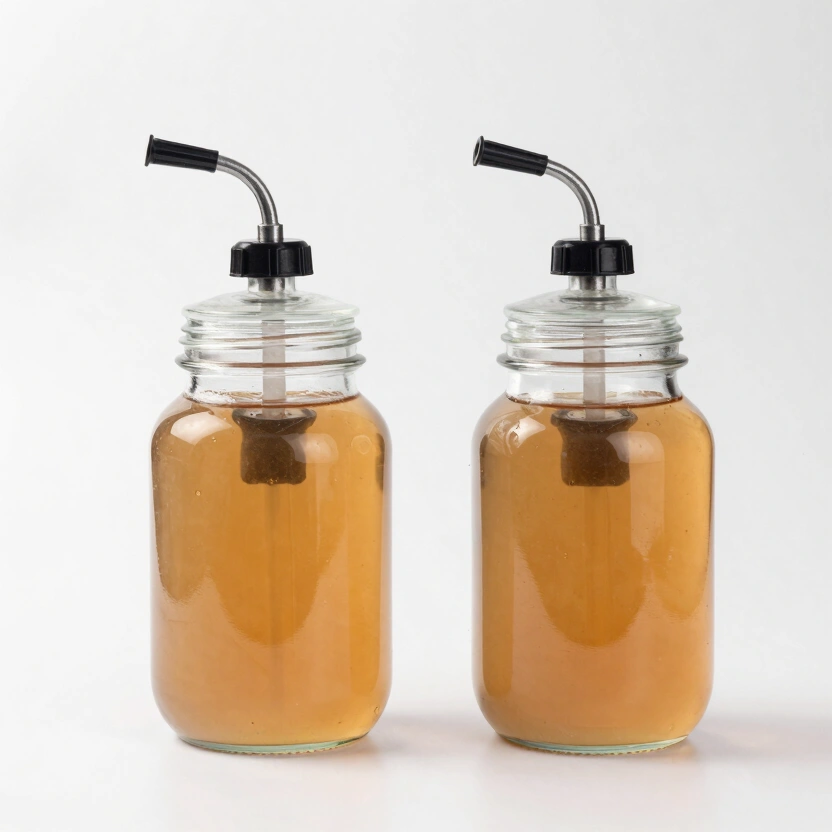
Green Wise Fermentation Jar Set (2 Pack)
Large 1.4L jars with integrated airlock valves. Perfect for sauerkraut, kimchi, or tomatoes.
Check Price on Amazon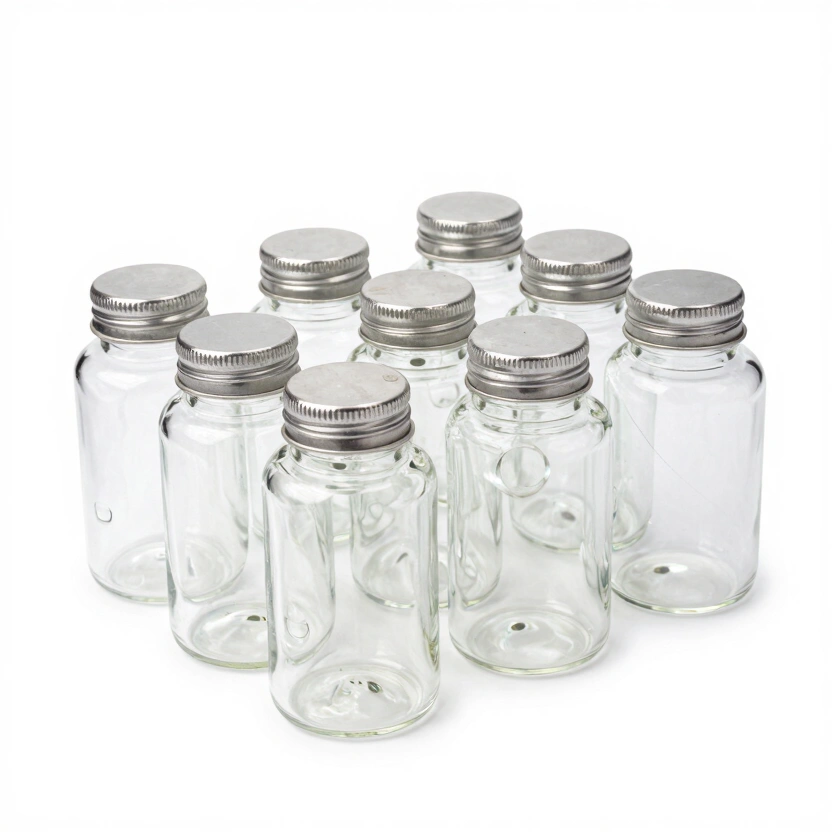
Artcome 10-Pack Glass Weights
Bulk set of heavy glass weights with easy-grip handles for large mason jar setups.
Check Price on Amazon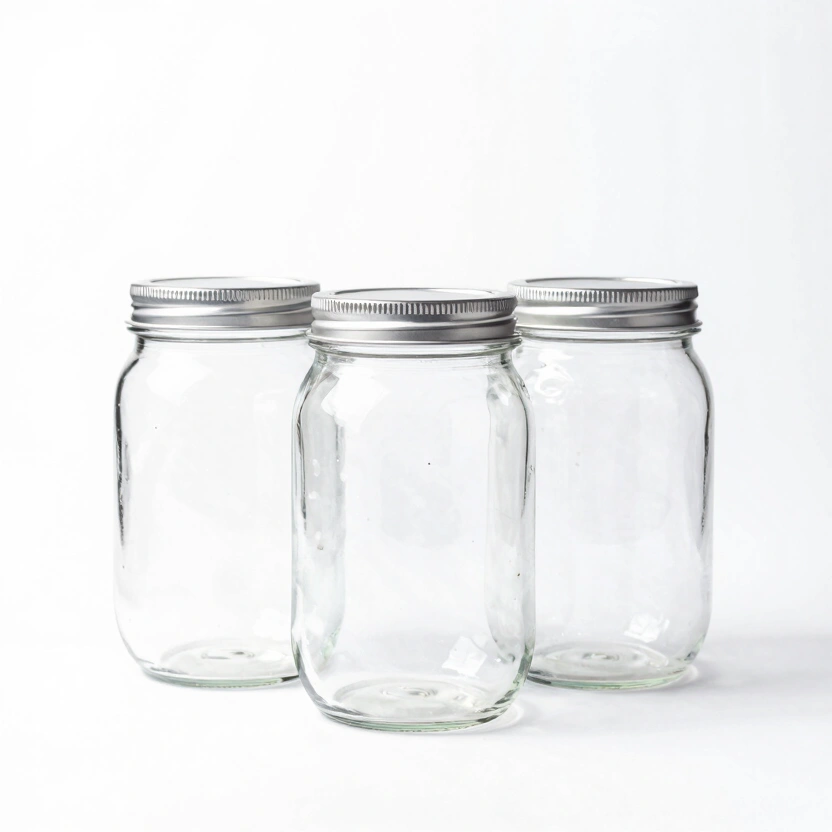
Tebery Wide Mouth Mason Jars (1.9L)
High-capacity glass jars perfect for bulk vegetable fermentation or continuous brew kombucha.
Check Price on Amazon* Affiliate links. Prices last updated March 6, 2026.
Vacuum Sealing: The Ultimate Anaerobic Weapon
One technique from commercial food processing has crossed over into home fermentation: Dry Vacuum Fermentation. You place salted vegetables into a vacuum bag and seal it mechanically.
Why it is superior:
- Mechanical Removal: Air is removed instantly.
- Zero Headspace: No air-water interface exists.
- Space Saving: Bags can be stacked easily.
Oxidation: The Visible Result of Oxygen Leaks
Vibrant green pickles turning dull brown or purple cabbage turning grey is Oxidation. Oxygen reacts with pigments and polyphenols. While not always “dangerous,” it is a clear indicator that your anaerobic seal is failing. Check your airlock and brine levels immediately.
Troubleshooting: When the Brine Level Drops
Brine levels often drop after the first few days as vegetables absorb liquid or CO2 bubbles push brine upward and out.
What to do:
- Don’t Panic: If they’ve only been exposed for a few hours, they are likely safe.
- Top off with 2% Brine: Never add plain water! Plain water dilutes salinity and raises pH. Add fresh 2% salt brine (20g/L).
- Degas: Press down on the vegetables to release trapped bubbles.
Gas Expansion Management: The “Explosion” Risk
Fermentation is a powerful biological engine. Solid lids without airlocks can lead to build-up until the glass fails.
- Mason Jars: Lids often “dome” upward before breaking.
- Airlocks: The only 100% safe way to manage gas passively.
An airlock and a glass weight. That’s the hardware bill for creating a complete anaerobic environment. Two pieces of equipment that cost under $20 and protect every batch you make from the most common failure modes in fermentation.
The Masontops Pickle Pipe’s differential valve maintains the CO2 shield without a single lid-lift — which means the oxygen-free blanket your Lactobacillus built stays intact from day one to day twenty-one. For the chemistry that the CO2 shield protects, pH levels and acidification speed determine the actual safety margin of every jar you make.
Frequently Asked Questions
Why does food above the brine line get mold even if everything else looks fine?
Because the brine line is the anaerobic boundary. Below it, lactic acid bacteria control the environment — the low pH, the salt concentration, and the lack of oxygen form a triple barrier against spoilage organisms. Above it, that barrier disappears. A single floating peppercorn or cabbage leaf sticking out of the brine is an aerobic surface where mold spores can land, germinate, and spread. Keep everything submerged, without exception.
Do I need an airlock for a 2-day ferment?
Not strictly. For very short ferments, a loose lid or a cloth cover allows CO2 to vent without creating significant oxygen ingress. But for anything over 5 days, an airlock system is worth using — especially because the anaerobic environment becomes more critical as acidity builds and you want to protect the maturing culture from contamination.
My brine level dropped and the vegetables were exposed for a few hours. Is the batch ruined?
Not necessarily. Inspect carefully: sniff for off-odors, check for mold or kahm yeast on the exposed surface. If the ferment has already reached pH 4.0 or below, a few hours of exposure rarely causes catastrophic contamination. Top off with fresh 2% brine (20g salt per liter of chlorine-free water) and reseal immediately.
Why do facultative anaerobes make lacto-fermentation reliable?
Because they don’t require a perfect oxygen-free environment from the first minute. Lactic acid bacteria survive in oxygen but switch their entire metabolic pathway to fermentation once oxygen is gone — producing lactic acid instead of CO2 and water. That automatic switch is what makes salt-brine fermentation forgiving enough for beginners. Seal the jar, submerge the vegetables, and the biology handles the transition on its own.
Related Articles
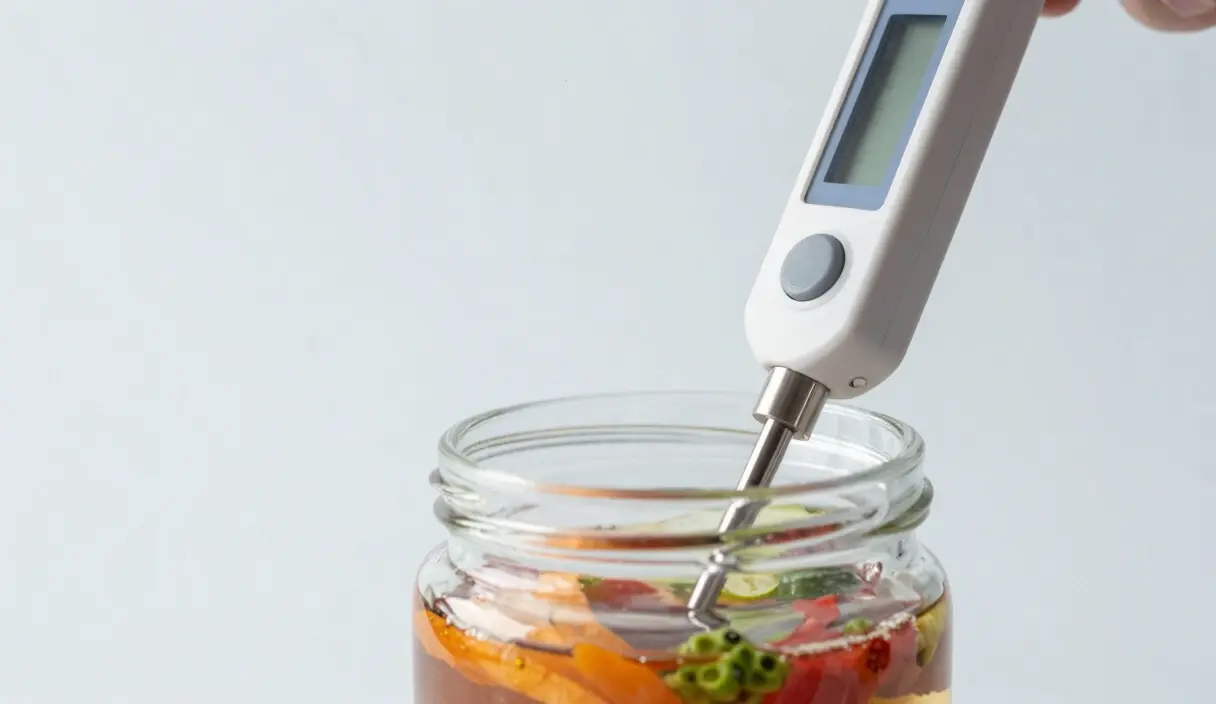
The Chemistry of Safety: Why pH 4.6 is the Critical Limit in Fermentation
A definitive guide to pH safety in home fermentation. Learn why 4.6 is the critical limit for preventing botulism and how to master acidity.

The Goldilocks Zone: Mastering Temperature Control in Fermentation
Temperature is the throttle of fermentation. Learn how to control the 'Goldilocks Zone' to achieve perfect flavor, texture, and safety.

Why is My Brine Cloudy? Understanding Bacterial Sediment and Safety
Is cloudy brine a sign of success or failure? We explain the science of microbial blooms, sediment, and how to verify the safety of your ferment.